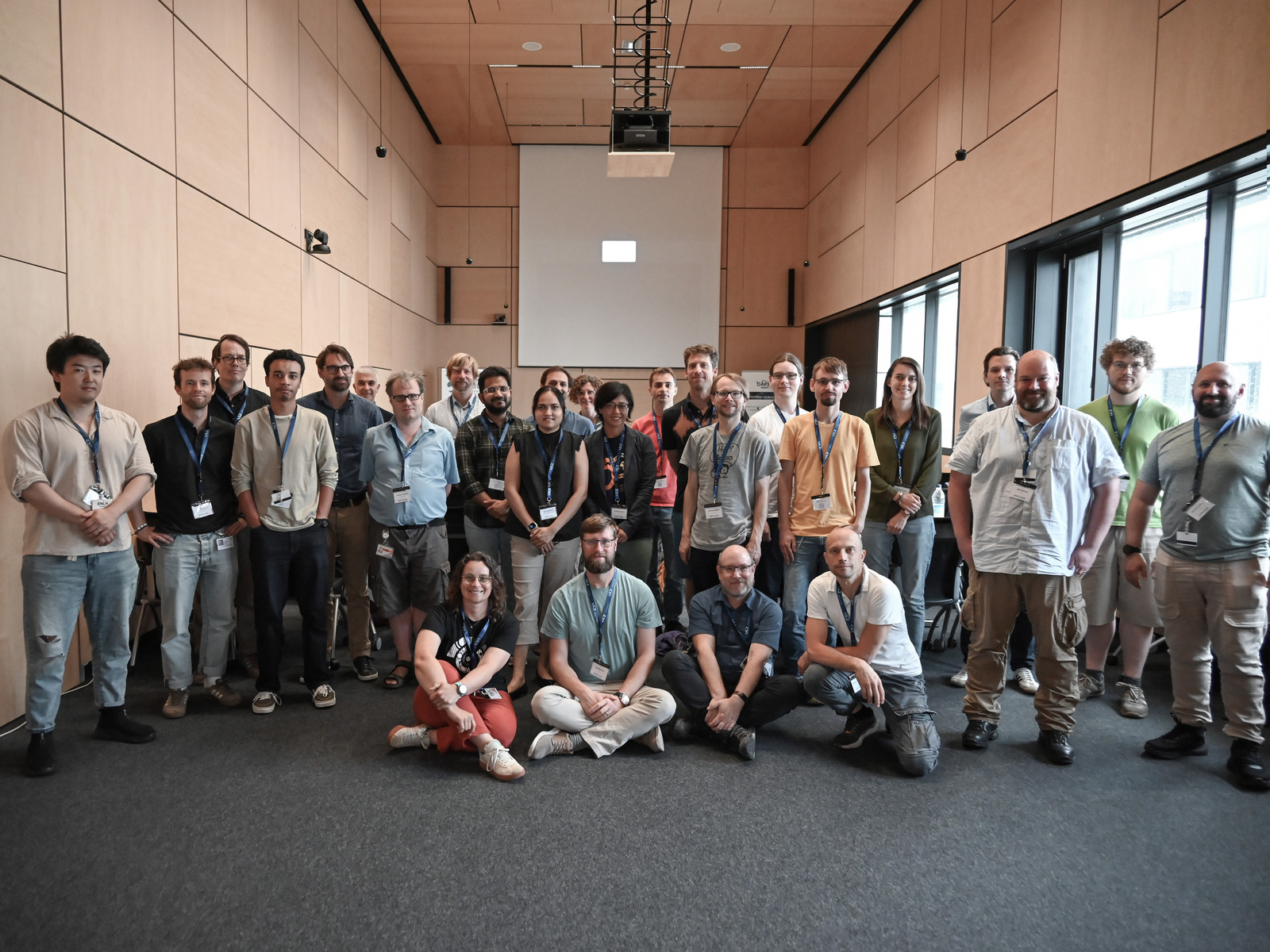
Celebrating 10 Years of Innovation: SciCatCon 2026 at MLZ Garching
The Heinz Maier-Leibnitz Zentrum (MLZ) in Garching recently hosted SciCatCon 2026, bringing together the international scientific data community for photon and neutron science. Used by large-scale facilities such as MLZ, SciCat is a community-driven metadata catalog designed to index, organize, and make scientific experimental metadata discoverable. This year’s conference marked the 10th anniversary of the open-source metadata catalog project (https://www.scicatproject.org/), which began in 2016. After a warm welcome by the MLZ Scientific Director Prof. Dr. Christian Pfleiderer (Technical University Munich (TUM)), international experts, developers, and data stewards gathered at the Jülich Centre for Neutron Science (JCNS) meeting room to share crucial institutional updates and actively shape the future of FAIR (Findable, Accessible, Interoperable, and Reusable) research data management in photon and neutron research.
Over the course of three days, the conference highlighted the progress across major European research facilities and key industry partners, showing how SciCat is increasingly used by large-scale facilities. Attendees gained valuable insights from comprehensive institutional updates spanning MLZ, Institut Laue-Langevin (ILL), Deutsches Elektronen-Synchrotron (DESY), Paul Scherrer Institut (PSI), and The Rosalind Franklin Institute (RFI).
A particular highlight of the presentations was an industry perspective presented by DECTRIS, which focused on integrating SciCat into cloud environments to support scientific reproducibility. A joint presentation by MAX IV and the European Spallation Source (ESS) demonstrated their collaborative efforts in developing a user-centered SciCat interface. The conference also included a librarian perspective, highlighting how modern metadata cataloging bridges the gap between raw experimental data and formal digital archiving.
The technical sessions focused on software engineering and data workflows. Presenters introduced automated metadata flows designed for seamless, automated publication processes. Innovation was also visible in user-interface enhancements, such as the implementation of Server-Sent Events (SSE) to enable real-time dataset table updates directly within the browser. Additionally, advanced talks focused on schema-driven metadata curation leveraging BlissData, simplifying the integration of DOI-ready workflows and beamtime data services right from the moment of measurement.
To support the growing project and ensure sustainable long-term development, a new governance framework was announced. Moving away from the traditional single-lead structure, the project is transitioning to a collective leadership model featuring three project leaders. This new governance framework is designed to distribute responsibilities more effectively among the core contributing institutions and to foster broader community engagement.
The second and third day featured hands-on breakout sessions where participants collaborated on seven key strategic areas: UI/UX redesign, Inside the Data architectures, Code Quality improvements, cloud and on-premise Deployments, Performance/Optimization bottlenecks, coordinated Release Strategies, Authorization, and the restructuring of the project's Documentation.
Beyond the technical program, the organizers provided networking opportunities, including guided tours of the instruments and the research reactor at the Garching campus facilities and a collaborative dinner. This combination of technical depth and community building highlighted SciCat’s value for modern scientific data infrastructures.
The event concluded with a session collecting and prioritizing work items for the next year. These will flow into the roadmap for the next year, which will be constructed by the SciCat Steering Committee in the next few weeks.
For those interested in browsing the detailed presentations, slide decks, and additional workshop materials, all talks are publicly available on the event’s official Indico page: https://indico.frm2.tum.de/e/scicat2026
The event was seamlessly organized by the local hosting team comprising Christian Felder (FZJ), Alexander Zaft (FZJ), Björn Pedersen (TUM), and Florian Koch (TUM), who deserve a special thank you for their excellent coordination and hospitality. We also extend our sincere gratitude to all speakers and participants for their valuable contributions and collaborative spirit. Thank you all for making this anniversary edition a resounding success and for shaping the next decade of SciCat together!
Authors: Christian Trageser, Christian Felder, Alexander Zaft, Björn Pedersen, Floarian Koch, Grunwaldt, Jan-Dierk