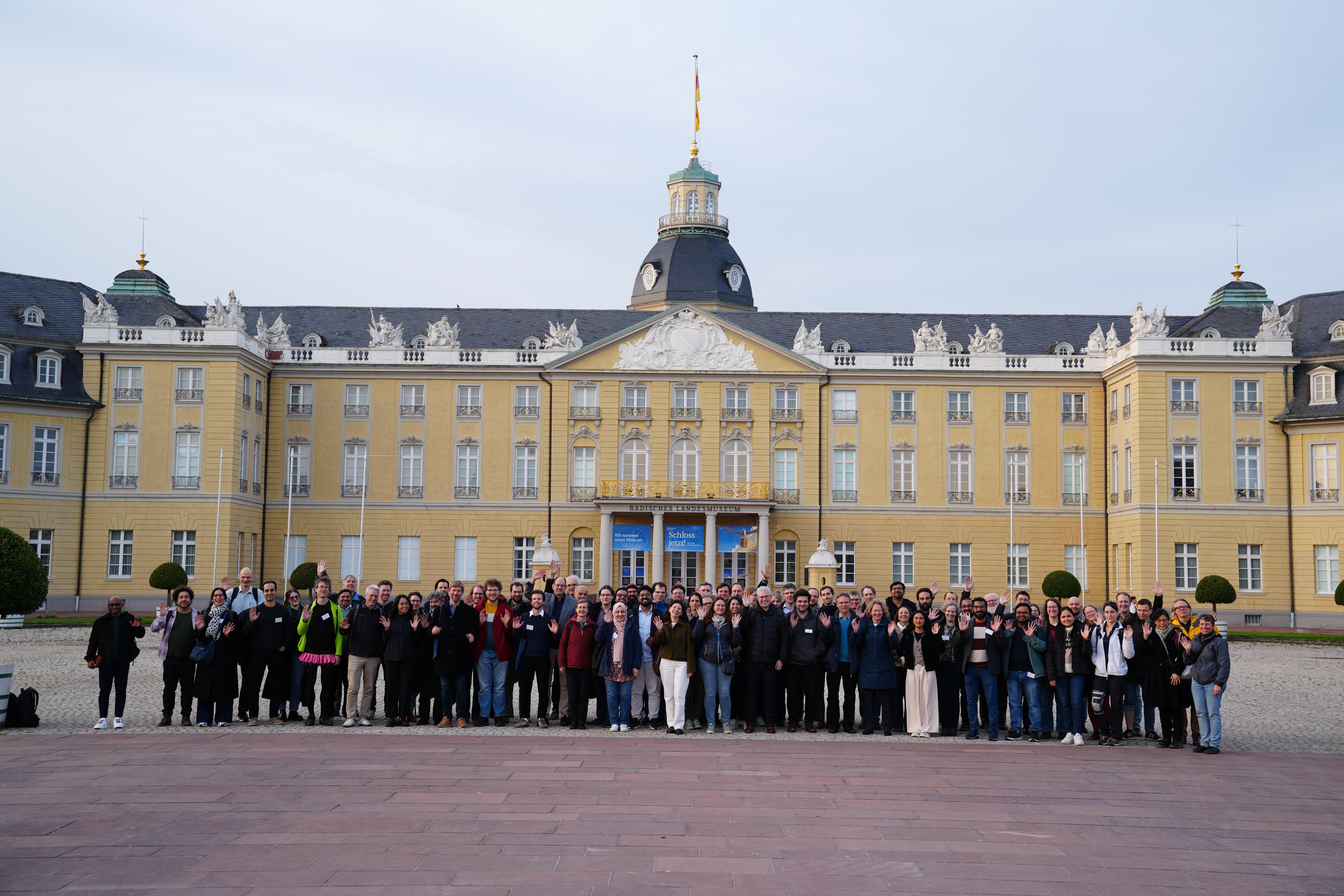
Annual Meeting of the DAPHNE4NFDI Community 2026 in Karlsruhe
Karlsruhe, from 23th to 25th of March, the Karlsruhe Institute of Technology (KIT) hosted the annual meeting of the DAPHNE4NFDI community. The event served as a central platform for networking among project partners and for the professional exchange on current advancements in Research Data Management (RDM) at photon and neutron sources.
The meeting opened with a welcome session led by Prof. Dr. Jan-Dierk Grunwaldt and Dr. Frank Weber (KIT), who greeted participants and emphasized the critical importance of joint infrastructure development. This was followed by a session on (Meta)Data Repositories and Catalogues, featuring presentations by Sebastian Busch on current developments and Abhijeet Gaur on the integration of RefXAS databases within the DAPHNE4NFDI framework.
In the subsequent session on digitization, Helena Simek Tosino highlighted the supporting role of NFDI4Chem, followed by Tilo Baumbach’s presentation of the MorphoSphere project. The first day concluded with a poster session, providing an environment for in-depth technical discussions.
The second day opened with a Cross-Consortia Session that provided a comprehensive overview of the German research data landscape, featuring contributions from Heiko Weber, who introduced the FAIRmat consortium, and Thomas Kuhr, who presented the ErUM-Data and DIG-UM initiatives. The session was further enriched by Thomas Schörner, who provided detailed insights into the PUNCH4NFDI and MatWerk consortia.
A dedicated section on Base4NFDI and Core Services focused on fundamental infrastructure offerings, including PID4NFDI, KGI4NFDI, and Terminology Services (TS4NFDI). The afternoon’s Industry Session explored private sector perspectives on FAIR Data within the photon and neutron ecosystem. Additional topics included the complexity of modern diffraction software, the decoding of organizational data in research infrastructures, and innovations within the DECTRIS Cloud.
The day rounded off with a "Europe Round-up," introducing continental initiatives such as PaNOSC, OSCARS, and Laser4EU, alongside a technical lecture on benchmarking machine learning robustness in X-ray absorption spectroscopy.
The final day focused on Software and Infrastructure, covering Task Area 3 (TA3) updates, UI/UX principles for GUI design, and the application of machine learning for Grazing Incidence Diffraction (GID). Notable highlights included the presentation of a pipeline for FAIR data management, the implementation of real-time XRR analysis at Beamline P08, and the introduction of "Crystal AI," a machine learning method specifically designed for structure determination from powder diffraction patterns.
The closing sessions addressed Managing Data Production, featuring the integrated data ecosystem at HZDR and case studies on virtual instruments in laboratory courses. The program concluded with reports on the MLZ-ELN, DOI minting at DESY, and general workflows in data production.
The meeting fostered interdisciplinary exchange, bridging the gap between early-career researchers and established scientists. A highlight of the final day was the visit from industrial guests and representatives of other NFDI consortia, such as Base4NFDI, strengthening the alignment between academic research and industrial application.
Poster Award Winners:
- Place: Sarah Heidrich (TU Berlin)
- Place: Dr. Julia Kobus (Kiel University) and Dr. Arnab Majumdar (Helmholtz-Zentrum Hereon)
The event concluded with a "World Café," an informal format allowing participants to discuss RDM tool integration into daily scientific workflows. With the momentum gained in Karlsruhe, the community looks forward to the challenges ahead and the further expansion of a world-class, data-driven research infrastructure.